Computer Associates Santa Clara: Company History, Software Products, and Technology Legacy

Silicon Valley's Santa Clara technology corridor, where enterprise software leaders like Computer Associates established key regional operations.
Computer Associates Santa Clara is a search term associated with Computer Associates, commonly known as CA, its enterprise software business, and its connection to Silicon Valley's technology industry. The company built a reputation for developing software that helped large organizations manage complex computer systems, protect business data, automate IT operations, and maintain critical applications.
Computer Associates later became known as CA Technologies. Its products supported enterprise computing environments ranging from traditional mainframe systems to distributed networks and modern business applications. In November 2018, Broadcom completed its acquisition of CA Technologies, bringing the company's enterprise software portfolio into Broadcom's broader infrastructure software business.
Understanding Computer Associates Santa Clara requires looking beyond a single office location. The company's history, software products, enterprise customers, and corporate evolution help explain why its name continues to appear in technology-related searches.
This guide explores the history of Computer Associates, its relationship with Santa Clara and Silicon Valley, its major software categories, the Broadcom acquisition, and the company's continuing relevance to enterprise IT.
What Is Computer Associates Santa Clara?
Computer Associates Santa Clara generally refers to searches connecting Computer Associates with Santa Clara, California, and the surrounding Silicon Valley technology ecosystem.
Computer Associates was an enterprise software company founded in 1976. Over time, it developed and expanded a broad portfolio of software used to manage business computing environments. The company later operated under the name CA Technologies, becoming known for products that supported mainframe management, application development, cybersecurity, automation, and IT operations.
Santa Clara is an important technology center in California's Silicon Valley, home to companies involved in semiconductors, enterprise computing, networking, cloud infrastructure, and software development. This regional context helps explain why searches for established technology companies often include the names of nearby cities.
However, the search phrase alone does not establish that Computer Associates was headquartered in Santa Clara or that a particular office remains open there. Anyone researching a historical office, employment location, or current business address should verify the exact site independently.
Why Is Computer Associates Santa Clara Still Relevant?
The name remains relevant for several reasons:
- Enterprise software history: Computer Associates became a significant provider of software for managing complex IT environments.
- Mainframe computing: Its software portfolio supported organizations that depended on large-scale enterprise systems.
- Business software innovation: The company expanded into application development, systems management, automation, and security-related products.
- Silicon Valley connections: Santa Clara's technology ecosystem makes the company name relevant to regional technology research.
- Corporate acquisition: The transition from Computer Associates to CA Technologies and then into Broadcom explains why different company names appear in historical records and product documentation.
These connections make the topic useful for readers researching technology companies, enterprise software, corporate history, and the evolution of IT infrastructure.
The History of Computer Associates
Computer Associates' history reflects several major changes in enterprise computing. As businesses moved from centralized mainframes toward networked systems and increasingly complex software environments, the company expanded its products to address new management requirements.
The Early Years: Computer Associates in 1976
Computer Associates was founded in 1976, initially focusing on software for mainframe computer environments.
Mainframes were central to many large organizations because they could process substantial workloads and support business-critical applications. Banks, insurance companies, government agencies, and other large institutions relied on these systems for transaction processing and essential operations.
Managing these environments required specialized software for monitoring performance, controlling workloads, maintaining availability, and supporting administrators.
Computer Associates developed its business around these requirements, building expertise in software that helped organizations operate their mainframe infrastructure.
Expansion Into Enterprise Software
As enterprise technology evolved, businesses needed to manage more than centralized computing systems. Client-server applications, distributed networks, and interconnected business platforms introduced new operational challenges.
Computer Associates responded by broadening its software portfolio through internal development and acquisitions.
Its products increasingly addressed areas such as:
- Systems and infrastructure management
- Application development and testing
- IT service management
- Workload automation
- Data protection and recovery
- Identity and access management
- Application performance monitoring
This expansion allowed the company to serve organizations operating across multiple technology environments.
The CA Technologies Era
Computer Associates adopted the CA Technologies name as its business evolved into a broader enterprise software provider.
The CA Technologies brand became associated with software that helped companies develop applications, manage infrastructure, protect information, and support business-critical systems.
During this period, enterprise IT was changing rapidly. Organizations were adopting virtualization, cloud computing, mobile applications, and hybrid infrastructure while continuing to depend on established mainframe environments.
CA Technologies' product portfolio reflected the need to connect these different systems and support the software that businesses relied on every day.
Broadcom Acquires CA Technologies in 2018
A major turning point came in July 2018, when Broadcom announced an agreement to acquire CA Technologies for approximately $18.9 billion in equity value. Broadcom completed the acquisition on November 5, 2018.
Following the transaction, CA became part of Broadcom's business, and its shares stopped trading separately on the Nasdaq.
The acquisition strengthened Broadcom's position in infrastructure software and expanded its enterprise software portfolio. It also marked the end of CA Technologies as an independent publicly traded company.
Today, readers researching older Computer Associates products may encounter documentation under several names: Computer Associates, CA, CA Technologies, and Broadcom.
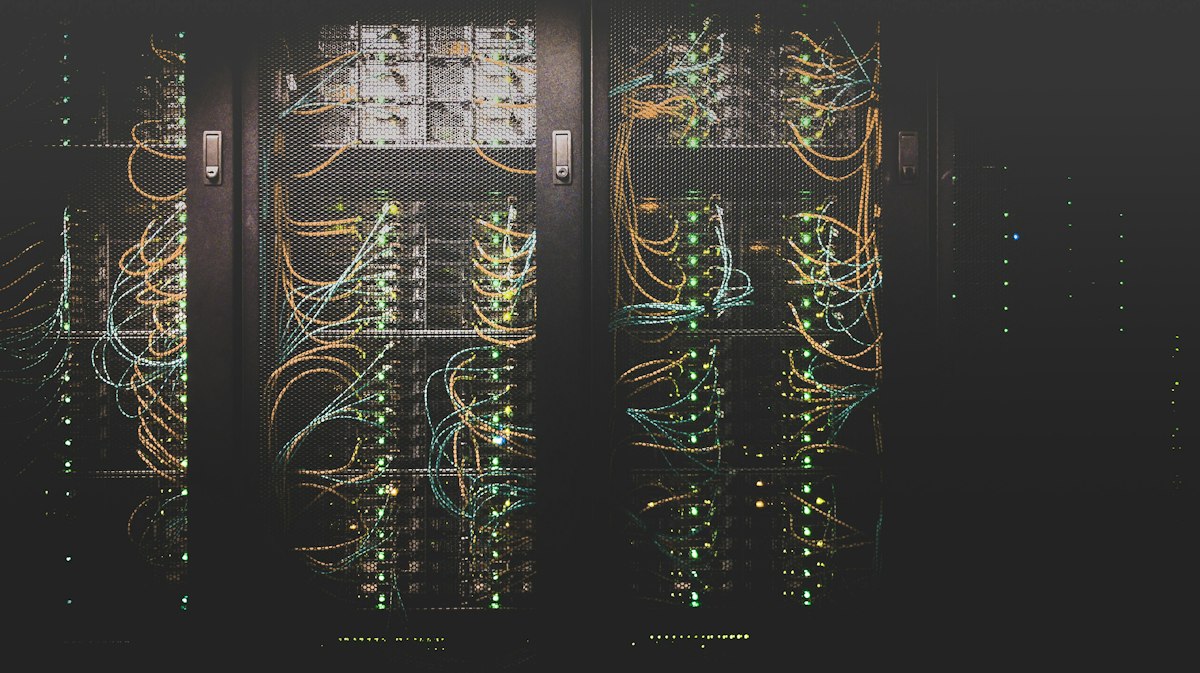
High-availability mainframe and datacenter infrastructure relied on Computer Associates solutions for workload automation, performance monitoring, and systems management.
Major Software Products and Solutions Associated With Computer Associates
Computer Associates developed a diverse portfolio of enterprise software. The exact products available today, their licensing terms, and their support arrangements depend on the individual product and its current status.
The following categories illustrate the company's historical areas of expertise.
1. Mainframe Management Software
Mainframe software was central to Computer Associates' early business.
Large organizations often use mainframes to process financial transactions, manage records, support customer accounts, and run other critical workloads. These systems require continuous monitoring and careful resource management.
Mainframe management software can help organizations:
- Monitor system performance and availability.
- Manage workloads and processing resources.
- Schedule recurring business operations.
- Identify operational issues.
- Support system reliability and continuity.
- Manage complex enterprise computing environments.
This category remains important because many organizations continue to rely on mainframes for essential business processes.
2. IT Operations and Infrastructure Management
Enterprise IT departments oversee servers, applications, networks, databases, and other interconnected systems. When these environments become more complex, administrators need tools to monitor performance and identify problems.
Computer Associates developed products for infrastructure and systems management, helping organizations understand and maintain their technology environments.
Typical capabilities associated with this software category include:
- Infrastructure monitoring
- Performance measurement
- Event and alert management
- Resource utilization analysis
- Operational automation
- Availability monitoring
The goal is to reduce service interruptions and help IT teams identify problems before they affect business operations.
3. Application Development and Testing
Enterprise applications must be developed, tested, deployed, and maintained throughout their lifecycles.
CA Technologies offered software supporting aspects of application development and testing. These tools helped development teams manage software quality and support more controlled delivery processes.
Application lifecycle management can include requirements management, software testing, release coordination, defect tracking, and collaboration between development and operations teams.
These capabilities are especially valuable in organizations where applications must meet strict reliability, security, and compliance requirements.
4. IT Service Management
IT service management, commonly abbreviated as ITSM, focuses on delivering and maintaining technology services in a structured way.
Enterprise IT teams use ITSM processes to handle incidents, service requests, changes, and recurring operational tasks.
Software in this category may support:
- Incident management
- Service request handling
- Change management
- Configuration tracking
- Service desk workflows
- IT asset management
- Service reporting
These processes help organizations standardize how technical issues are reported, investigated, resolved, and documented.
5. Workload Automation
Many enterprises run thousands of scheduled jobs, data transfers, reports, and application processes.
Workload automation software coordinates these activities so that tasks run in the correct sequence and according to defined business rules.
For example, a financial organization may need to process data, reconcile transactions, generate reports, and distribute results in a specific order. Automation software can help coordinate these dependencies and provide visibility into execution.
This category is particularly relevant to organizations with complex mainframe and distributed computing environments.
6. Data Protection and Recovery
Data protection is essential for businesses that must maintain access to important records and recover from system failures.
Software in this category can support backup operations, recovery planning, data availability, and the protection of business information.
Organizations evaluating older Computer Associates data protection products should confirm the current product name, supported operating systems, licensing conditions, and maintenance arrangements before deploying or renewing a solution.
7. Security and Identity Management
Enterprise security requires more than protecting individual devices. Organizations also need to control access to applications, systems, databases, and sensitive information.
CA Technologies had products associated with identity management and enterprise security. These solutions supported areas such as authentication, access control, and management of user permissions.
The general objectives of identity and access management include:
- Ensuring users have appropriate permissions.
- Reducing unauthorized access.
- Applying consistent access policies.
- Supporting auditing and compliance.
- Managing user identities across enterprise systems.
Current product capabilities and support status should be confirmed through the present product owner rather than assumed from historical descriptions.
Computer Associates Santa Clara and Silicon Valley's Technology Ecosystem
Santa Clara is part of Silicon Valley, a region known for semiconductor manufacturing, software engineering, networking, enterprise computing, and technology research.
The regional ecosystem includes large technology companies, startups, research organizations, suppliers, and service providers. These organizations contribute to the development of the infrastructure that powers modern businesses.
The Computer Associates Santa Clara search phrase fits into this broader technology context, particularly for people investigating enterprise software companies and their historical presence in California.
Why Santa Clara Matters to Technology Companies
Santa Clara offers access to a dense network of technology businesses and professionals. Its wider regional ecosystem includes expertise in:
- Semiconductor and chip design
- Enterprise software engineering
- Cloud and data center infrastructure
- Networking and communications
- Cybersecurity
- Technical consulting and IT services
- Product development and research
This concentration of technology expertise makes the area relevant to corporate offices, engineering teams, technology partnerships, and enterprise software development.
It is important, however, to separate the general importance of Santa Clara from claims about a specific company address. The phrase Computer Associates Santa Clara should not be treated as proof of a current office or official headquarters.
Enterprise Software and the Silicon Valley Connection
Silicon Valley is often associated with consumer technology and startups, but enterprise software has also played an important role in the region's development.
Enterprise software supports the internal operations of large organizations. Unlike consumer applications, it may need to operate continuously, process high volumes of transactions, meet regulatory requirements, and integrate with older systems.
Computer Associates built much of its business around these complex requirements. Its history illustrates how enterprise technology companies evolved alongside the changing needs of large organizations.
Computer Associates vs. CA Technologies vs. Broadcom
One common source of confusion is the relationship between the three names.
They refer to different stages in the company's corporate history rather than three unrelated software businesses.
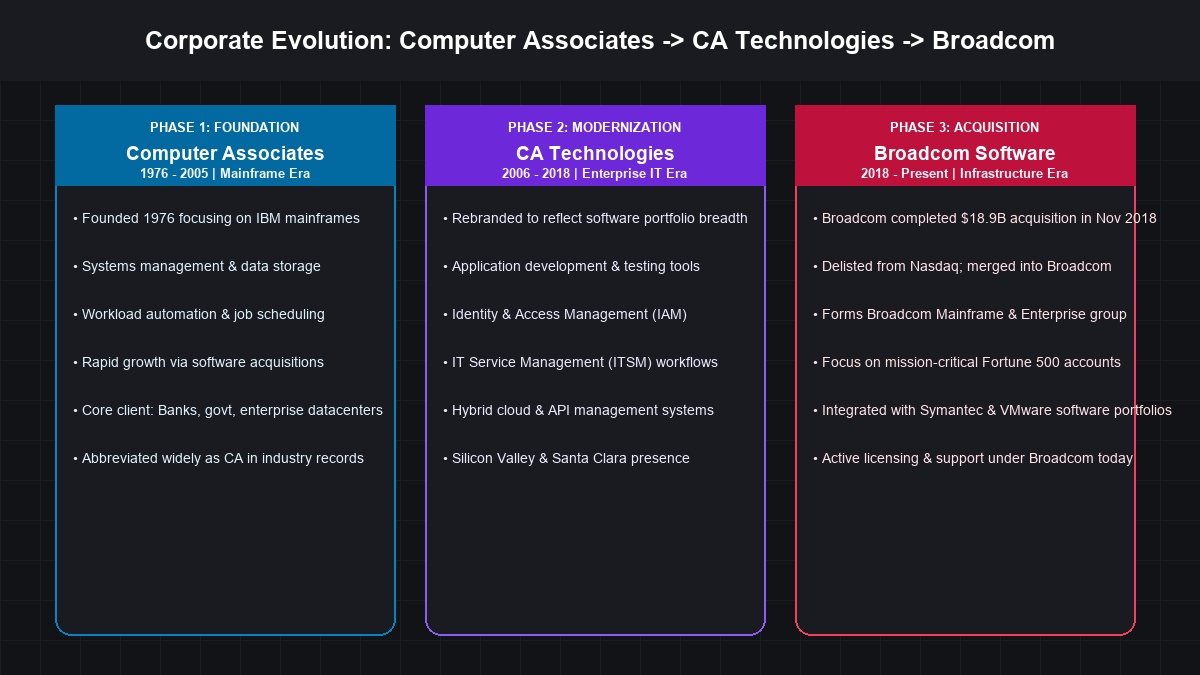
Corporate evolution timeline showing Computer Associates' expansion from 1976 mainframe roots to CA Technologies and Broadcom's 2018 infrastructure software acquisition.
| Name | Meaning | Historical context |
|---|---|---|
| Computer Associates | Original company identity | Founded in 1976 with a focus on enterprise computing software |
| CA | Common abbreviation for Computer Associates | Used across company communications and product references |
| CA Technologies | Later corporate brand | Reflected the company's broader enterprise software portfolio |
| Broadcom | Acquiring company | Completed the acquisition of CA Technologies in November 2018 |
Understanding these distinctions is helpful when researching old product manuals, support articles, job listings, business records, and enterprise software licenses.
For example, a product document may use the CA Technologies name even though the product is now associated with Broadcom. In other cases, older references may continue to use Computer Associates or CA.
The relevant name depends on the document's publication date and the product's current ownership.
How Computer Associates Influenced Enterprise IT
Computer Associates contributed to the development of enterprise IT by building software for the systems that large organizations depend on.
Its legacy is connected to several important areas.
Supporting Mission-Critical Systems
Many enterprises cannot easily replace the systems that manage transactions, customer records, and operational processes.
Mainframe management and automation software helps organizations maintain these environments while controlling risk and supporting reliable service.
Managing Complex Technology Environments
Modern businesses often use a mixture of mainframes, distributed servers, databases, cloud services, and business applications.
Enterprise management software helps IT teams monitor these components and coordinate operations across different platforms.
Improving Operational Visibility
Monitoring and management tools can give administrators better visibility into system performance, failures, resource utilization, and application behavior.
This information can help teams investigate problems and plan infrastructure changes.
Supporting Software Lifecycle Management
Enterprise applications require ongoing development, testing, deployment, maintenance, and security updates.
Tools that support application lifecycle management help teams organize these activities and reduce avoidable errors.
Connecting Legacy Systems With Modern IT
A company's older systems may continue to perform critical functions even as new cloud-based applications are introduced.
Managing both environments is a continuing challenge for large enterprises. The history of Computer Associates reflects the importance of software that supports established systems alongside evolving technology.
What to Check Before Using a Former Computer Associates Product
Organizations researching legacy CA software should verify current product details before making purchasing or implementation decisions.
A historical product description may not accurately represent its present capabilities, support arrangements, or licensing requirements.
Use this checklist when evaluating a product:
- Current product name: Determine whether the original name has changed.
- Product ownership: Confirm which company currently manages the product.
- Support lifecycle: Check whether the software remains supported and maintained.
- Compatibility: Verify support for your operating system, hardware, and infrastructure.
- Licensing: Review the current license agreement and renewal conditions.
- Security updates: Determine whether patches and security fixes remain available.
- Migration options: Understand the available upgrade or replacement paths.
- Documentation: Use product-specific technical documentation for accurate configuration guidance.
These checks are particularly important for organizations that depend on legacy enterprise applications and cannot risk an unsupported deployment.
Frequently Asked Questions About Computer Associates Santa Clara
1. What is Computer Associates Santa Clara?
Computer Associates Santa Clara is a search phrase connecting Computer Associates, its enterprise software history, and the Santa Clara technology ecosystem. It does not, by itself, confirm the existence of a current company office at a particular address.
2. What was Computer Associates known for?
Computer Associates was known for enterprise software used in mainframe management, IT operations, application development, workload automation, data protection, and related areas of business technology.
3. Is Computer Associates the same as CA Technologies?
Computer Associates and CA Technologies are names associated with the same corporate history. The company later adopted the CA Technologies brand as its enterprise software business expanded.
4. Who acquired CA Technologies?
Broadcom completed its acquisition of CA Technologies on November 5, 2018. CA became part of Broadcom's business, expanding its infrastructure software portfolio.
5. Is Computer Associates still an independent company?
No. CA Technologies was acquired by Broadcom in 2018 and ceased to be a separately publicly traded company. Product ownership and support should be checked through current Broadcom information.
6. What software did Computer Associates develop?
Its historical portfolio included mainframe management, systems monitoring, IT service management, application development and testing, workload automation, data protection, and security-related products.
7. Was Computer Associates headquartered in Santa Clara?
The search phrase alone does not establish that Santa Clara was the company's headquarters. Anyone researching a historical office or headquarters should verify the address using reliable corporate records from the relevant period.
8. Why is Santa Clara important to the technology industry?
Santa Clara is part of Silicon Valley, a major technology region with businesses involved in semiconductors, software, cloud infrastructure, networking, cybersecurity, and enterprise IT.
9. Can businesses still use CA Technologies products?
The availability and support status of individual products vary. Businesses should verify the current product name, licensing, compatibility, and support lifecycle before continuing to use or purchase a particular solution.
10. Why do older documents still mention Computer Associates?
Historical manuals, technical documentation, contracts, and articles may retain the company's earlier name. These records can remain useful for understanding a product's origin, even when its ownership or branding has changed.
Conclusion
Computer Associates Santa Clara connects the history of a major enterprise software company with the wider technology ecosystem of Silicon Valley. Founded in 1976, Computer Associates developed software that helped organizations manage mainframes, automate IT operations, support applications, protect data, and maintain complex computing environments.
The company later became CA Technologies and expanded its role in enterprise software. Broadcom's acquisition in November 2018 marked another significant stage in its history, explaining why modern product information may appear under Broadcom rather than the original Computer Associates name.
For readers researching Computer Associates Santa Clara, the most important distinction is between the company's historical identity, its enterprise software legacy, and any claim about a specific current office or product. Understanding these connections provides a clearer picture of the company's role in enterprise computing and its continuing relevance to technology research.
For more such useful information read our site plusstoriescom.shop
Related Business Guides
CNLawBlog: Complete Guide to the Website, Legal Content, Topics & What to Know
What is CNLawBlog? Learn about CNLawBlog.com, its legal and business content, technology, finance, Chinese law resources, editorial approach and how to use the site.

OnlyWorkMoods com: Complete Guide to the Website, Content, Categories, Safety & What to Know
What is OnlyWorkMoods com? Learn about the OnlyWorkMoods website, categories, safety, productivity app distinction, content quality, and research guidelines.